
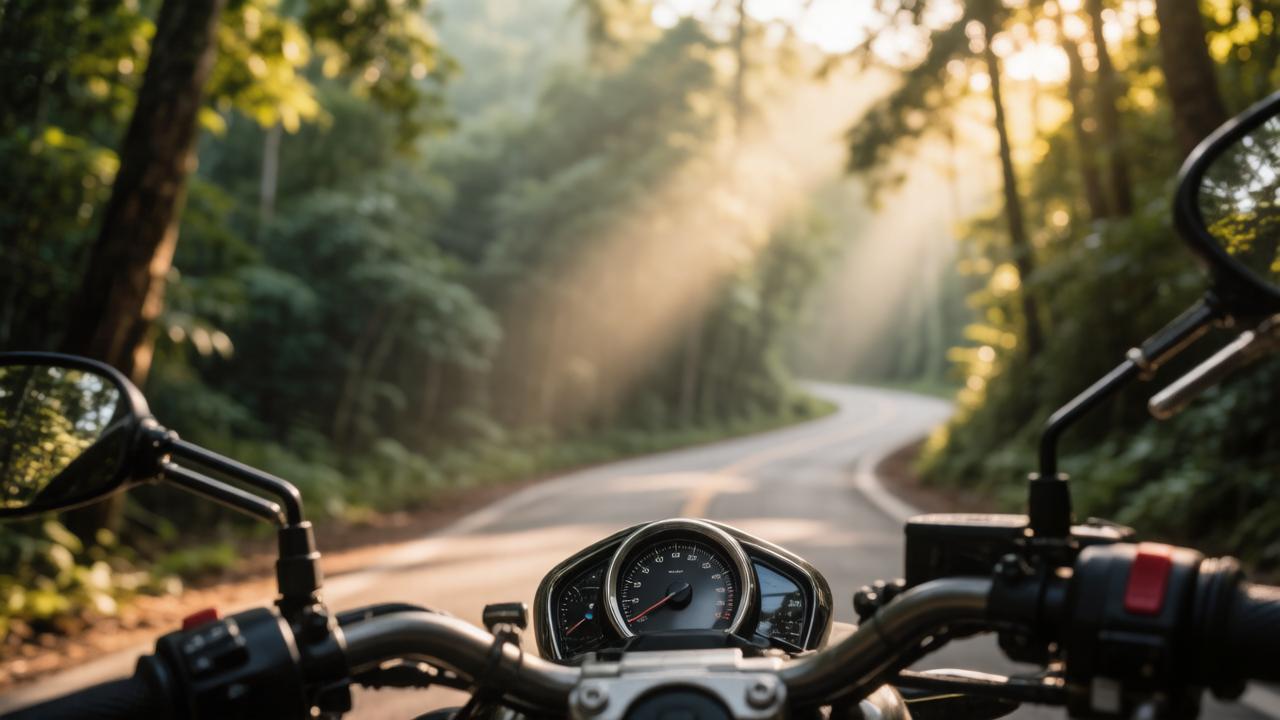
The mountainous terrain surrounding the ancient valley of Northern Thailand offers some of the most visually spectacular and technically rewarding riding conditions in Southeast Asia. However, transitioning from flat city streets to high-elevation alpine routes introduces a completely different set of physical forces, environmental hazards, and mechanical demands. Securing a premium motorbike rental in Chiang Mai is merely the baseline of your preparation; knowing how to manage your weight distribution, control your braking temperatures, and read unpredictable mountain topography is what ultimately determines the safety of your expedition.
Whether you are planning a day trip up the steep slopes of Doi Suthep or launching a multi-day trek into the remote peaks of Doi Inthanon—the highest mountain in Thailand—you will encounter extreme road gradients that easily exceed 15% to 18% in incline. For an inexperienced or unprepared rider, these vertical changes can quickly overwhelm both the vehicle’s mechanical capacity and the operator’s skills. This comprehensive technical guide breaks down the advanced riding methodologies, safety systems, and hazard-mitigation strategies required to master Northern Thailand’s majestic mountain passes.
The Physics of Extreme Inclines: Managing Power and Momentum
When riding a modern automatic scooter up a steep mountain pass, gravity constantly works against your vehicle’s engine. Many riders make the mistake of keeping the throttle wide open for extended periods, assuming the transmission will handle the load automatically. In reality, continuous high-load riding at low road speeds restricts the cooling airflow to your engine and continuously slips the centrifugal clutch, leading to severe overheating and sudden mechanical failure deep in the wilderness.
To ascend safely, you must develop a feel for your machine’s momentum. If you feel the engine beginning to bog down or lose RPMs on a steep switchback, slightly ease off the throttle and find a steady, mid-range sweet spot where the engine can breathe. If you are carrying a passenger (pillion), your center of gravity shifts drastically backward. To compensate for this and prevent the front wheel from losing vital traction or lifting entirely on vertical crests, lean your upper body forward over the handlebars to keep weight firmly distributed over the front suspension forks.
The Danger Zones: Anatomy of High-Elevation Hazards
Mountain roads in the north are beautifully paved, but their tropical environment creates unique, localized hazards that can surprise unsuspecting motorists. Below are detailed profiles of the most common and dangerous road anomalies you will encounter above 1,000 meters elevation:
1. Microclimates, Condensation, and Moss Accumulation
The Hazard Location: Dense jungle canopies on northern mountain slopes (e.g., Doi Inthanon Highway 1009).
Technical Analysis: High peaks generate their own localized weather systems. You can leave the city center in bone-dry, sunny weather, only to find thick fog, heavy mist, and damp asphalt at the summit. Because the dense jungle canopy blocks direct sunlight from reaching the road surface, moisture lingers permanently on the asphalt, promoting the growth of a nearly invisible layer of slick green moss. Treat every damp patch under heavy tree shade as an oil slick; completely avoid leaning your bike or braking aggressively while passing through these shaded zones.
2. The Micro-Gravel and Sand Washout Phenomenon
The Hazard Location: Outer apexes of sharp, descending mountain switchbacks.
Technical Analysis: During afternoon tropical downpours, rainwater cascades down the mountain walls, washing loose gravel, red clay, and fine sand directly across the road surface. As water flows away, this debris settles directly into the natural apexes and gutters of sharp corners. If your tires strike a patch of loose micro-gravel while your scooter is leaned over in a turn, the tires will instantly lose lateral traction, resulting in a low-side crash. Always scan the road 20 to 30 meters ahead of your vehicle and choose a wider, cleaner riding line that completely bypasses debris accumulation.
Advanced Downhill Braking: Preventing Brake Fade and Fluid Boiling
While climbing a mountain tests your vehicle’s engine, descending a mountain is a brutal, direct test of your braking system. Gravity accelerates your vehicle rapidly down steep slopes, requiring continuous speed management. Relying solely on your mechanical brakes to slow down a heavy automatic scooter during a long descent is a critical safety mistake that leads to an incredibly dangerous condition known as “brake fade.”
Brake fade occurs when the extreme friction between the brake pads and the spinning brake discs generates immense heat. This heat transfers directly into the hydraulic brake fluid, causing it to boil. Once the fluid boils, gas bubbles form within the brake lines, making the brake levers feel completely soft and spongy when squeezed, and resulting in a sudden, total loss of braking power. To prevent this catastrophic failure, implement these three strict technical protocols:
- Utilize Natural Engine Braking: Automatic scooters do not have manual gears, but they do have engine braking. As long as the centrifugal clutch remains engaged, the engine will naturally slow the rear wheel. Never turn off your engine or coast downhill with the throttle completely closed at zero. Keep a tiny, fractional amount of throttle applied to keep the clutch system locked into the drivetrain, allowing the engine’s internal compression to naturally regulate your descent speed.
- Implement the “Pump and Release” Method: Never apply continuous, dragging pressure to both brake levers for kilometers at a time. Instead, use firm, progressive pressure to slow your vehicle down before a corner, and then completely release the levers on straight stretches. This brief release introduces a flow of cool air across the brake pads and discs, allowing the thermal energy to dissipate safely.
- Alternate Braking Bias Dynamically: Distribute your braking work unevenly between the front and rear wheels. Apply strong pressure to the front brake (which provides roughly 70% of your total stopping power) for a few hundred meters, then transition the primary workload to the rear brake while letting the front system cool down. Alternating the thermal stress ensures that at least one braking circuit remains perfectly cool and functional at all times.
Fuel Logistics in Remote Mountain Regions
Fuel efficiency drops significantly when fighting steep vertical inclines. A full tank of fuel that easily lasts 150 kilometers on flat city terrain might be completely exhausted within 60 kilometers of aggressive mountain climbing. Standard commercial fuel stations (such as PTT, Shell, or Caltex) are completely non-existent once you enter deep national park boundaries.
When traveling remote mountain routes, adopt the “Half-Tank Rule.” The moment your digital fuel gauge drops down to the halfway mark, your absolute top priority must shift to finding a fuel source. In remote hill-tribe villages, look for small roadside wooden shacks displaying a collection of recycled glass whiskey bottles filled with an orange or green liquid—this is local gas (91 or 95 octane). Alternatively, look for small, blue, automated coin-operated fuel boxes. While this rural fuel is more expensive per liter than city commercial stations, keeping your tank topped off guarantees you will never find yourself stranded on a dark mountain pass after sunset.